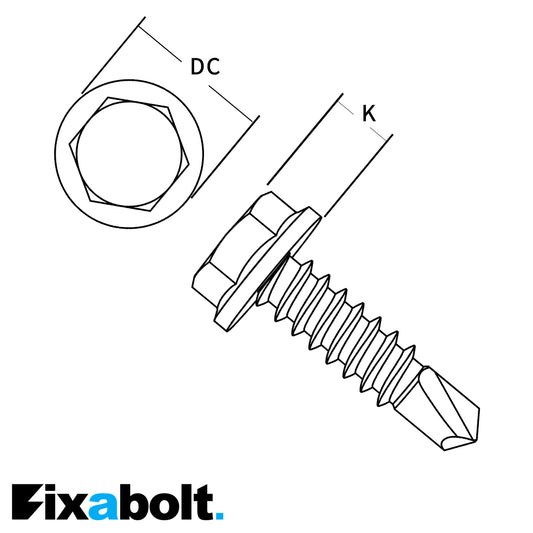
Suitable for roofing, cladding, steel fabrication, HVAC installation, agricultural buildings and general construction work, these self-drilling screws provide reliable performance across a wide range of trade applications.
Performance Specs & Standards
DIN 7504K Stainless Steel Tek Screws
feature a self-drilling point designed to cut through thin metal sheets without the need for a pilot hole.
- Standard: DIN 7504K - hex head, self-drilling tip for direct fastening into sheet metal
- Thread type: Metric thread with coarse pitch for strong material grip
- Common diameters: 4.8mm, 5.5mm, and 6.3mm. Available in various lengths
- Material: A2 (304) stainless steel from head to tip.
A2 Bi-Metal Self-Drilling Screws
Our A2 bi-metal Tek screws are manufactured using a hardened carbon steel drill point permanently bonded to an A2 stainless steel body and head.
This construction offers several advantages:
- Faster, more consistent drilling into light gauge steel
- Improved drilling performance compared with conventional stainless steel self-drilling screws
- Excellent long-term corrosion resistance from the exposed stainless steel body and head
- Ideal where both drilling performance and corrosion resistance are required
Hex Head Stainless Steel Tek Screws
Hex head self-drilling screws are a popular choice among stainless steel self-drilling fixings due to their strong driving power and ease of installation. The external hex head is designed for use with a standard socket or spanner, making them quick and reliable to fit on site.
They're similar to coach screws, which are self-tapping as opposed to self-drilling, and are ideal for securing metal components in construction, fabrication, and general building work.
Where They’re Ideal
These tek screws are trusted across industries for:
- Roofing and cladding installations (metal-to-metal or metal-to-wood)
- HVAC ductwork fastening
- Metal frame assembly and structural steelwork
- Outdoor projects
- Assemblies subject to moisture, vibration, or harsh climates
Pick a drill-point size that exceeds material thickness to avoid tip failure. Can be used with stainless steel EPDM bonded washers.
Choosing the Right Screw
At Fixabolt, we supply stainless steel self-drilling screws in the most widely used sizes for trade and construction use, including 4.8mm, 5.5mm, and 6.3mm diameters.
- 4.8mm – Ideal for lighter gauge metal and general-purpose fixing
- 5.5mm – A versatile mid-range size suitable for most metal-to-metal applications
- 6.3mm – A heavier-duty option for higher grip strength in structural work
Our self-drilling screws are made from A2 stainless steel, which offers reliable corrosion resistance in outdoor or damp conditions, while the hardened drill point cuts through thin steel without pre-drilling.
Choose the right diameter and length based on the material thickness and holding strength required. If you're fixing through thicker sections or need extra bite, the larger diameters provide better performance.
If you're looking for hex head fasteners without a drill point, try our stainless steel hex bolts instead.
Why Fixabolt® Stainless Self‑Drilling Screws?
- Quality materials: Grade 304 stainless and bi-metal options
- Standard hex head available, other styles coming soon
- Reliable UK delivery: Tracked dispatch for trades and DIYers
- Volume discounts: Bulk buy options to suit every project size
Browse our full range of stainless steel self-drilling screws in stock now — trusted by trades across the UK.
Fixabolt®. No fuss, no guesswork - just reliable, ready-to-use fastening solutions.
Frequently Asked Questions (FAQs)
Q. What are stainless steel self‑drilling screws?
Stainless steel self‑drilling screws (also known as Tek screws) have a tip shaped like a drill bit, designed to create their own hole and thread in one go, so no pilot hole needed.
Q. Can these screws drill through steel sheet?
A2 stainless (304) self‑drilling screws are suitable for thin metal sheet, such as single-layer steel, aluminium, or Aluzinc. All stainless (including stainless tip) may struggle with thicker steel so you may want to you use a bi-metal or hardened tip option.
Q. How do I choose the right size and drill-point?
Pick a diameter (4.8mm, 5.5mm, or 6.3mm) and length based on material thickness. Screw tip capacity is rated in mm so ensure the screw point exceeds the thickness being fastened.
Q. What drill speed and torque should I use?
Use moderate drill speed, smaller screws can be higher, larger screws slower. Avoid excessive torque or heat, which may dull the tip or snap the head.
Q. Are stainless self‑drilling screws rust-proof?
Yes. A2 (304) stainless resists corrosion in outdoor, humid, and coastal environments, standing up much better than zinc-plated or carbon-steel alternatives.
Q. Can I reuse self‑drilling screws?
It’s possible, but not recommended. The screw hole may be slightly enlarged, compromising holding power. It’s best to use a fresh screw or one of a slightly larger diameter.
Q. What’s the difference between self‑drilling and self‑tapping screws?
All self‑drilling screws are also self‑tapping because they create their own threads. However, self‑tapping screws (like coach screws) require a pre-drilled pilot hole, whereas self‑drilling types do not. See our article on self-drilling vs self-tapping screws.
Q. Why do some screws fail to drill?
Common causes include:
- Material too hard for A2 tip. In these cases, choose a bi-metal option
- Drill speed too high, overheating and blunting the tip
- Improper torque causing twist-out or binding
- Mounting through rubber or soft composites that resist cutting